Amplifon Data Breach Class Action Lawsuit Investigation
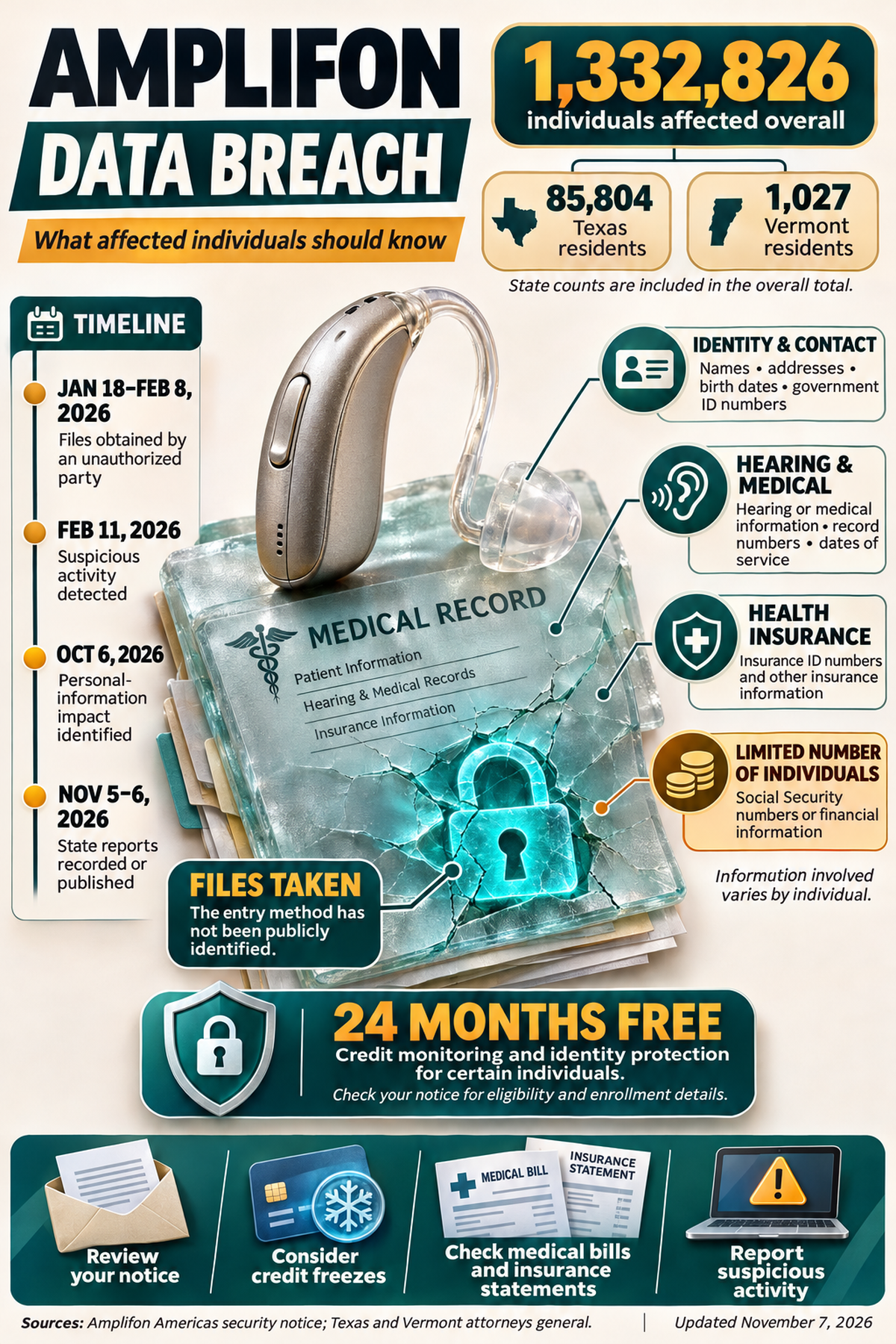
Data breach law firm Abington Cole + Ellery is investigating potential legal claims related to the Amplifon data breach, which reportedly affected about 1,332,826 individuals and may have exposed names, contact information, dates of birth, driver’s license or other state identification numbers, and other government-issued identification numbers, hearing or medical information, medical record numbers, dates of service, other health information, health insurance identification numbers, and other insurance information as well as financial information or Social Security numbers for a limited number of individuals.
JOIN THIS INVESTIGATION: If you are interested in potentially volunteering to serve as a class representative in a class action lawsuit against Amplifon, please submit your information to be considered:
You may also open the form here: Amplifon Data Breach Lawsuit Form. An attorney-client relationship is not formed by submitting information through this website.
Amplifon Data Breach: Key Facts
| Company: | Amplifon Americas |
|---|---|
| Location: | Minneapolis, Minnesota |
| Incident Type: | Data Breach |
| Number Affected: | APPROXIMATELY 1,332,826 |
| Data Involved: | names, contact information, dates of birth, driver’s license or other state identification numbers, and other government-issued identification numbers, hearing or medical information, medical record numbers, dates of service, other health information, health insurance identification numbers, and other insurance information as well as financial information or Social Security numbers for a limited number of individuals |
| Date Began: | January 18, 2026 |
| Date Discovered: | February 11, 2026 |
| Date Ended: | February 8, 2026 |
| Notice Date: | November 5, 2026 |
| Credit Monitoring: | 24 months of free credit monitoring and identity protection services to certain affected individuals |
| Status: | Class Action Lawsuit Investigation |
What happened in the Amplifon data breach?
Amplifon Americas announced a data breach involving files taken from certain systems within its network between January 18 and February 8, 2026. The incident was reported to state regulators under the name Amplifon (USA), Inc. The underlying data for Texas Attorney General filing BR-0005495 identifies 1,332,826 affected individuals overall, including 85,804 Texas residents. Vermont separately lists 1,027 affected residents. Sources: Amplifon Security Incident Notice; Texas Attorney General Data Security Breach Reports; Vermont Attorney General Security Breach Notices
Amplifon detected suspicious activity on February 11, 2026, and began an investigation with outside cybersecurity specialists. The company states that it notified law enforcement, contained the incident, disabled affected accounts, and increased monitoring. Investigators found evidence that an unauthorized third party had obtained files. The public disclosure does not identify how the intruder first gained access, name a software vulnerability, or confirm that ransomware was involved. Source: Amplifon Security Incident Notice
On October 6, 2026, a review of the affected data indicated that personal information may have been involved. Potentially affected records included identifying information, contact details, hearing or medical information, and health insurance information. Financial information or Social Security numbers were involved for a limited number of individuals. The specific information affected may differ from person to person. Source: Amplifon Security Incident Notice
The Vermont Attorney General recorded Amplifon’s report on November 5, 2026, and the Texas Attorney General published its entry on November 6, 2026. The Texas filing identifies consumer notification through U.S. mail and a website. Amplifon’s public statement says it will notify potentially affected individuals for whom it has a valid mailing address. Sources: Amplifon Security Incident Notice; Texas Attorney General Data Security Breach Reports; Vermont Attorney General Security Breach Notices
Amplifon offers 24 months of free credit monitoring and identity protection to certain affected individuals, including those whose financial information or Social Security numbers were affected. Eligible recipients will receive enrollment information in their notices. The company states that it is unaware of fraudulent use of personal information resulting from the incident, while encouraging recipients to review financial statements and insurance explanations of benefits for suspicious activity. Source: Amplifon Security Incident Notice
How did the Amplifon data breach occur?
An unauthorized third party obtained files from certain systems within Amplifon’s network. The company has not publicly explained how access was gained or identified a specific vulnerability. Its disclosure does not establish whether the incident involved phishing, ransomware, stolen credentials, or a third-party service provider. Source: Amplifon Security Incident Notice
When did the Amplifon data breach occur?
The reported breach period was January 18 through February 8, 2026. Amplifon detected suspicious activity on February 11, 2026. On October 6, 2026, its review indicated that personal information may have been involved. October 6 therefore represents the identification of the personal-information impact, rather than the company’s initial detection of suspicious activity. Source: Amplifon Security Incident Notice
How many people were affected by the Amplifon data breach?
Texas filing BR-0005495 reports 1,332,826 affected individuals overall, including 85,804 Texas residents. Vermont reports 1,027 affected residents. The national figure appears in the Texas filing’s underlying “Total Number of Individuals Affected” field, rather than its visible Texas-resident count. A complete state-by-state breakdown has not been verified. Sources: Texas Attorney General Data Security Breach Reports; Vermont Attorney General Security Breach Notices
What information was exposed in the Amplifon data breach?
- The Amplifon Americas data breach potentially involved names, contact information, dates of birth, driver’s license or other state identification numbers, and other government-issued identification numbers. The Texas filing specifically includes addresses among the affected information categories. The public disclosures do not establish that every listed category was involved for every affected individual. Potentially affected health information included hearing or medical information, medical record numbers, dates of service, other health information, health insurance identification numbers, and other insurance information. Amplifon also states that financial information or Social Security numbers were affected for a limited number of individuals. Recipients should review their individual notices to determine which information was associated with them. Sources: Amplifon Security Incident Notice; Texas Attorney General Data Security Breach Reports; Vermont Attorney General Security Breach Notices
- Names
- Contact information, including addresses
- Dates of birth
- Driver’s license or other state identification numbers
- Other government-issued identification numbers
- Hearing or medical information
- Medical record numbers
- Dates of service
- Other health information
- Health insurance identification numbers
- Other health insurance information
- Financial information, for a limited number of individuals
- Social Security numbers, for a limited number of individuals
Has Amplifon offered free credit monitoring and/or identity theft protection services?
Yes. Amplifon offers 24 months of free credit monitoring and identity protection services to certain affected individuals, including those whose financial information or Social Security numbers were affected. Enrollment information will be included in eligible individuals’ notification letters. The public statement does not identify the monitoring provider or an enrollment deadline, and it does not describe the offer as available to every affected person. Source: Amplifon Security Incident Notice
Amplifon Data Breach Timeline
| Date | Event |
|---|---|
| January 18–February 8, 2026 | An unauthorized third party obtained files from certain Amplifon systems. Source: Amplifon Security Incident Notice |
| February 11, 2026 | Amplifon detected suspicious activity. The company began an investigation, notified law enforcement, and took containment measures. Source: Amplifon Security Incident Notice |
| October 6, 2026 | A review of the affected data indicated that personal information may have been involved. Source: Amplifon Security Incident Notice |
| November 5, 2026 | Vermont recorded Amplifon’s breach report, listing 1,027 affected Vermont residents. Source: Vermont Attorney General Security Breach Notices |
| November 6, 2026 | Texas published Amplifon’s report, listing 85,804 affected Texans. The filing’s underlying data reports 1,332,826 affected individuals overall. Source: Texas Attorney General Data Security Breach Reports |
Who is Amplifon?
Amplifon Americas is the regional hearing care business of the Amplifon Group, with headquarters in Minneapolis, Minnesota, and operations in the United States, Canada, and Latin America. Its U.S. businesses include Miracle-Ear, which provides hearing aids and related services through company-owned and franchised locations, and Amplifon Hearing Health Care, which administers hearing benefits and connects health plan members with hearing care providers. Sources: Amplifon Website; Amplifon Regional Operations; Amplifon: Who We Are
What should you do if you received a Amplifon data breach letter?
If you received an Amplifon Americas data breach notification, review it carefully to understand which personal information may have been affected and whether you are eligible for free credit monitoring and identity protection. The steps below can help you monitor for suspicious activity, protect your financial and health information, and respond to signs of identity theft. Source: Amplifon Security Incident Notice
-
- Review and preserve the notification. Read the notice carefully to identify the information affected and any instructions or deadlines. Keep the letter and related correspondence. If an email or text appears suspicious, verify it through Amplifon’s official website before clicking links or providing personal information. Sources: Amplifon Security Incident Notice; FTC: How To Recognize and Avoid Phishing Scams
- Enroll in the free protection services if eligible. Follow the instructions in your verified notification to activate the offered 24 months of credit monitoring and identity protection. Check the letter for the enrollment deadline and any activation code. Questions about the incident or eligibility can be directed to Amplifon’s incident assistance line at 844-971-8634, Monday through Friday, 8:00 a.m. to 5:30 p.m. Central time, excluding major U.S. holidays. Source: Amplifon Security Incident Notice
- Consider freezing your credit. A credit freeze restricts access to your credit file and can make it harder for someone to open new credit accounts in your name. Freezes are free and must be placed separately with Equifax, Experian, and TransUnion. They remain in place until lifted. Credit monitoring can help detect suspicious activity, but it does not provide the same protection as a freeze. Source: FTC: Credit Freezes and Fraud Alerts
- Consider a fraud alert. An initial fraud alert asks businesses to take additional steps to verify your identity before issuing credit. It is free and lasts one year. Contacting one of the three nationwide credit bureaus is sufficient because that bureau must notify the other two. Source: FTC: Credit Freezes and Fraud Alerts
- Review credit reports and financial accounts. Obtain free credit reports through AnnualCreditReport.com and look for unfamiliar accounts, inquiries, or other unexpected changes. Review bank and credit card statements and promptly report suspicious transactions to the financial institution involved. Sources: AnnualCreditReport.com; IdentityTheft.gov
- Monitor medical bills and insurance activity. Review explanations of benefits, medical bills, and available patient records for appointments, prescriptions, hearing devices, or services you did not receive. Contact your insurer and the provider about unfamiliar activity. If incorrect treatment information appears in your medical records, request copies and submit a written correction request. Source: FTC: What To Know About Medical Identity Theft
- Watch for follow-up scams. Be cautious about unexpected messages offering breach assistance, refunds, or insurance verification. Avoid sharing passwords, verification codes, or sensitive information with unsolicited callers. Contact organizations through a known website or independently verified telephone number, and enable multifactor authentication where available. Source: FTC: How To Recognize and Avoid Phishing Scams
- Report identity theft and document any harm. If personal information is misused, report the incident at IdentityTheft.gov to obtain a recovery plan. Retain disputed bills, correspondence, receipts, and a dated record of time spent addressing the problem. These records can help support disputes and assist an attorney in evaluating any potential claim. Sources: IdentityTheft.gov; FTC: What To Know About Medical Identity Theft
Sources & Additional Information About the Amplifon Data Breach
-
- Amplifon Website
- Amplifon Security Incident Notice
- Texas Attorney General Data Security Breach Reports
- Vermont Attorney General Security Breach Notices
- FTC: How To Recognize and Avoid Phishing Scams
- my Social Security
- Medicare.gov: Reporting Medicare fraud & abuse
- FTC: Checking Your Credit Report
- FTC: Credit Freezes and Fraud Alerts
- AnnualCreditReport.com
- FTC Consumer Advice: Identity Theft
- IdentityTheft.gov
- IRS Identity Theft Guide for Individuals
- IRS Identity Theft Guide Central
- IRS: Get an identity protection PIN (IP PIN)
- U.S. Department of Health and Human Services Office of Inspector General: Medical Identity Theft
- FTC: What To Know About Medical Identity Theft
- IdentityTheft.gov: What To Do if Your Information Was Lost or Stolen, or Part of a Data Breach
Class Action FAQ
About This Data Breach Resource
This page was created to give affected individuals and researchers a clear, comprehensive explanation of the Amplifon data breach. It summarizes what is currently known about the incident, including the timeline, how the breach was discovered, the types of information involved, the number of people affected when available, important notice dates, and steps individuals may want to take after receiving a data breach notification.
This resource is independently written and organized to help readers understand the breach without having to review multiple notices, state attorney general filings, company statements, and related materials. When available, this page relies on primary sources and identifies key facts, unanswered questions, and updates as new information becomes public.
This page is especially relevant for readers searching for information about the Amplifon data breach, Amplifon data breach notice, Amplifon class action investigation, what information was exposed, how many people were affected, and what affected individuals should do next.
Abington Cole + Ellery reviews data breach incidents involving sensitive personal information, financial information, and protected health information. This page is intended to help affected individuals understand the publicly reported facts, the types of information that may have been involved, and practical steps that may reduce the risk of identity theft or medical identity theft.
The information on this webpage is provided for general informational purposes only and does not constitute legal advice. Nothing on this page should be relied upon as legal advice for any particular situation. Submitting information through this page does not create an attorney-client relationship.
For more information about steps you can take to possibly reduce the risk harm arising from a data breach, please review the following article: What are some steps you can take if you've been the victim of a data breach?
This website is not associated with nor authorized by Amplifon or any affiliated companies. If you have received any other data breach notifications, you may want to review Abington Cole + Ellery's current list of data breach investigations.